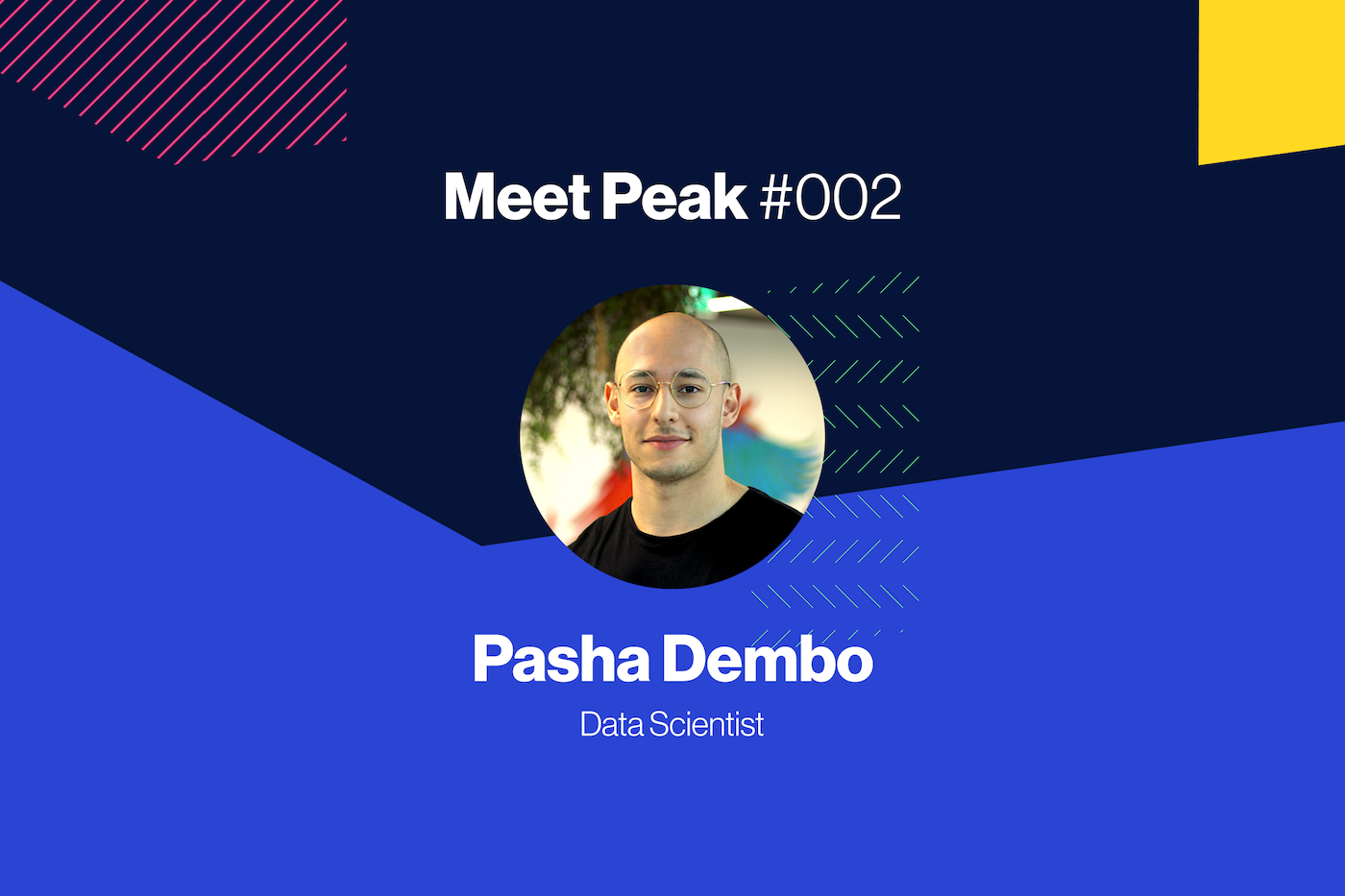

Meet Peak: Pasha, Data Scientist
By Jon Taylor on March 10, 2020Welcome back to the second installment of Meet Peak, our monthly blog series dedicated to getting to know our team. In the hot seat this month, it’s data scientist Pasha Dembo...
Thanks for joining us, Pasha – tell us a bit about yourself!
Sure! I’m a data scientist at Peak, and I joined about a year-and-a-half ago. Before that I studied at Lancaster University – I did my Bachelor’s in Computer Science and a Master’s degree in Data Science. As part of my Master’s, I was lucky enough to do an internship at Peak. This went really well, I fell in love with the place, and applied to come back and work full-time – and I’ve been part of the Peak familia ever since!
For someone non-technical, how would you explain what data science is?
Data science as a field as a whole is about looking at a lot of data, and trying to see if it is telling you something; whether or not you can extract some info from there that you can then use to your advantage later down the line. It’s about uncovering hidden patterns in data and being able to use them to your advantage. It’s a hard one to describe in layman’s terms!
Cool! So what’s the best thing about being a data scientist at Peak?
I think we’re in a very privileged position, really, because you get to work on a lot of different things, and that’s not something that a lot of data scientists get to do! I work in our Customer AI function, working on problems that involve other businesses and their customer base – problems like churn, lead scoring, stuff like that – so that’s very exciting. I guess one of the big perks of working at Peak is that the work you do doesn’t get stale – it always keeps moving and you always get exposure to different problems, projects, and tasks!
You mentioned ‘Customer AI’ – how is the team structured at Peak?
So, data science at Peak is split into three big functions that match our solutions – Customer AI, Demand AI, and Supply AI. Within each function there are different pods which consist of three to five members of data science that you’ll work closely with. So, in Customer AI we try to solve mostly B2C problems, but some B2B as well – mostly trying to uncover and solve problems our clients have that involve their own customers.
Sounds good! Let’s go back to your uni days – did you move to the UK specifically for university?
Yes, I’m originally from Latvia – the capital, Riga. When I was in high school, I had to make a decision on whether to stay in Latvia, or go and study abroad. At that time, opportunities abroad were a lot more exciting – the tech sector in Latvia is lagging behind – so that was a motive to move here to study.
Was it always going to be the UK you moved to?
Because of English, it was either UK or USA. At the time I received an offer from Lancaster, which was the best choice at the time. The US was maybe a little too far, and I wasn’t ready to go so far from my home country and my family. So the UK seemed like a good middle ground!
What was it like going from a capital city to a small town like Lancaster?
A little bit of a change! But, it was alright really because I set myself into a specific mentality – I was all about “I have to focus, I have to do well, I have to study.” I wasn’t too much about the party life. Obviously, like every student I had my fair share of fun and had a nightlife, but I wasn’t really going abroad for that purpose.
And you live in Manchester now, right?
Yes, not too far away from the office, about a 25 minute walk. I love walking to work – in the morning it allows me to get ready for the day, think about the problems I’m going to be solving, and then in the evening, when I walk home, it allows me to reflect on what I’ve done and maybe start a little bit of planning for tomorrow.
How does Manchester compare to Riga?
They’re quite similar in size. Population-wise they’re about the same but Riga is a little bit more spread out, with a larger territory. In terms of the central area, it feels like Manchester is a lot more compact, but there’s a lot more going on here. Obviously it’s one of the UK’s largest cities, so there’s definitely a lot more development. But, nevertheless, Riga is still my hometown so it’s always nice to go back there and see how things are going.
Do you go home often?
I try to go home every month or two, depending on how it aligns with annual leave or public holidays. I go quite often because I have a big family, a lot of siblings, and my girlfriend is there, so I have to try and see everyone as much as I can, basically. I also try to convince them to come here, too – but they’re too lazy!
Tell us about your hobbies – what do you like doing in your free time?
My biggest passion is fitness, and I do spend a lot of time in the gym. I’m into powerlifting – that’s all about specializing in three basic movements; squatting, deadlifting and bench, and trying to be the strongest version of yourself. Obviously, within reason and not to hurt your body, because lifting heavy can be harmful. This is something I picked up about six months before I joined Peak, and ever since then, I’ve been in love with it.
Going to the gym is just one part of it, too – you also have to maintain good and consistent nutrition, sleep, and stuff like that, so it takes a lot of time and commitment. Some may argue whether or not it’s worth it, but I personally enjoy it! Outside that, I enjoy walking – the place where I live is close to a large park so I like taking strolls around there and listening to podcasts and things like that.
Do you like any other sports?
I don’t watch much sport nowadays, no. I used to play tennis before, so I’d say tennis will always have a place in my heart!
Nice. Are there any famous Latvian tennis players?
There’s a female player who’s doing really well, Jelena Ostapenko, who won the French Open in 2017. There’s also a male player, Ernests Gulbis, who has been on the pro scene for the past 13 years but has had rocky performances – he isn’t always at the top, but will sometimes play against the likes of Federer, Nadal and co.
What advice would you give to anyone going to study in a new country?
Just do it! It’s going to be hard at times, but remember that, in the long run, it’s going to be beneficial. In the short term, if you’re leaving your family and your home country and going somewhere alone, it may seem scary at first and you might start doubting yourself and wondering why you’re doing it and whether it’s worth it. But you need to think about it long term and look at the bigger picture – you’ll be doing yourself a lot of favors now that, later down the line when you’re older, you’ll be thankful for.
Don’t be afraid, just be yourself and try it out! It’s scary at first but it’s great. Personally, I didn’t know anyone when I came, but now I know tons of people around the country and every one is a wonderful person, so I’m very happy that I made that decision to come here and start my adult life here.
Awesome! Similarly, what advice would you give to someone looking to get started in a career in data science?
I think you really need to have a passion for problem solving. Data science is a skill that you apply to something, so you use your knowledge of data science and various other techniques that you can apply to large datasets to help solve complicated problems. It’s down to us to figure out and dissect business problems into very manageable blocks, to be able to address them and solve them step by step. You need to have that passion and love for problem solving, and you also can’t really run away from the mathematics aspect of it. Also, it doesn’t harm if you know how to code and how to actually transform those theoretical and mathematical concepts into a sequence of steps that your computer can then go through, analyze, and then output the sort of results that you’re looking for.
Tell us something about you that that people might not know
Because I’m from Latvia, people think that my native language is Latvian, but it’s actually Russian and I speak it fluently. It’s because of how things happened historically – Latvia was under heavy influence of Russia during and after the USSR times, so a big portion of the Latvian population were influenced by Russian culture or came from families that were maybe Russian themselves. So, obviously, they spoke Russian in their family home and that’s a similar case to me – my parents were born in Latvia and are Latvians, but in our family we speak Russian to each other.
Interesting! Are they similar languages?
No, Latvian is based on the Latin alphabet whereas Russian is Cyrillic – so it’s totally different.
Do you speak any other languages?
English, obviously! Russian is my mother tongue, I speak Latvian but not quite as well, and I also speak a little bit of French too.
Magnifique! Thanks for chatting to us today, Pasha!
You’re welcome! I also want to give a shout out to the PSC (Peak Strength Club) – see you in the gym, guys! ?